Introduction
Engineering managers overseeing municipal water infrastructure, industrial cooling systems, and subsea inspection face mounting pressure to minimize downtime, reduce diver risk, and cut operational costs. Bureau of Labor Statistics data records 1,030 confined-space fatalities from 2011–2018, including 19 deaths specifically in water and septic tanks.
Draining a single large reservoir compounds those risks with operational ones — infrastructure goes offline for days and thousands of gallons of water are lost in the process.
The shift from hydraulic and diver-dependent approaches to electro-mechanical underwater actuators and robotic motion systems is accelerating. Bosch Rexroth's latest subsea electrification technology consumes up to 75% less power than legacy hydraulics. Purpose-built robotic platforms now enable tanks and reservoirs to stay online during cleaning and inspection, removing confined-space entry risk without the disruption of draining.
This guide evaluates the best underwater motion alternatives available in 2026, covering depth ratings, communication protocols, drive types, and fit for industrial versus subsea applications.
TL;DR
- Underwater motion systems for 2026 include electro-mechanical actuators, pressure-compensated ROV drives, and robotic cleaning platforms across varying depth ranges
- Key selection criteria: depth rating, communication protocol (RS-232, RS-485, CAN), actuator type (linear vs. rotary), and in-service tank operation capability
- Top alternatives include NV Mechanics Design Ltd., Ultra Motion, Moog Subsea, Deep Trekker, and Bosch Rexroth Subsea Hydraulics
- For municipal and industrial tanks, no-drain, no-diver systems cut maintenance costs and keep water supply online during cleaning
Overview of Underwater Motion Systems in the Robotics and Infrastructure Industry
Underwater motion systems encompass electro-mechanical or hydraulic components—actuators, thrusters, and robotic platforms—that generate controlled mechanical movement in submerged environments for inspection, cleaning, valve control, or structural manipulation.
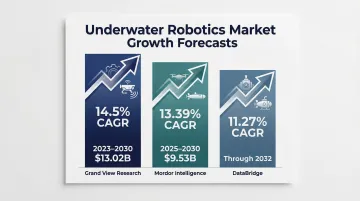
Applications span potable and wastewater reservoirs, industrial cooling towers, offshore energy infrastructure, and defence/research subsea platforms. That breadth of application is driving significant market expansion. The global underwater robotics market is projected to reach between $9.53 billion and $13.02 billion by 2030, with deep-water exploration, offshore wind operations, and the shift from hydraulic to electro-mechanical systems all contributing to that growth.
Market Growth Highlights
- Grand View Research forecasts 14.5% CAGR from 2023-2030, reaching $13.02 billion
- Mordor Intelligence projects 13.39% CAGR from 2025-2030, reaching $9.53 billion
- DataBridge anticipates 11.27% CAGR through 2032
Best Underwater Motion Alternatives for 2026
Selections are based on depth rating, actuation technology, integration flexibility, communication protocol support, operational reliability in harsh environments, and relevance to municipal, industrial, and subsea applications.
NV Mechanics Design Ltd.
Canada-based NV Mechanics Design Ltd. is a fast-growing robotics company specializing in remotely operated systems for underwater inspection, cleaning, and environmental applications—particularly for potable and wastewater tanks, reservoirs, and industrial cooling systems.
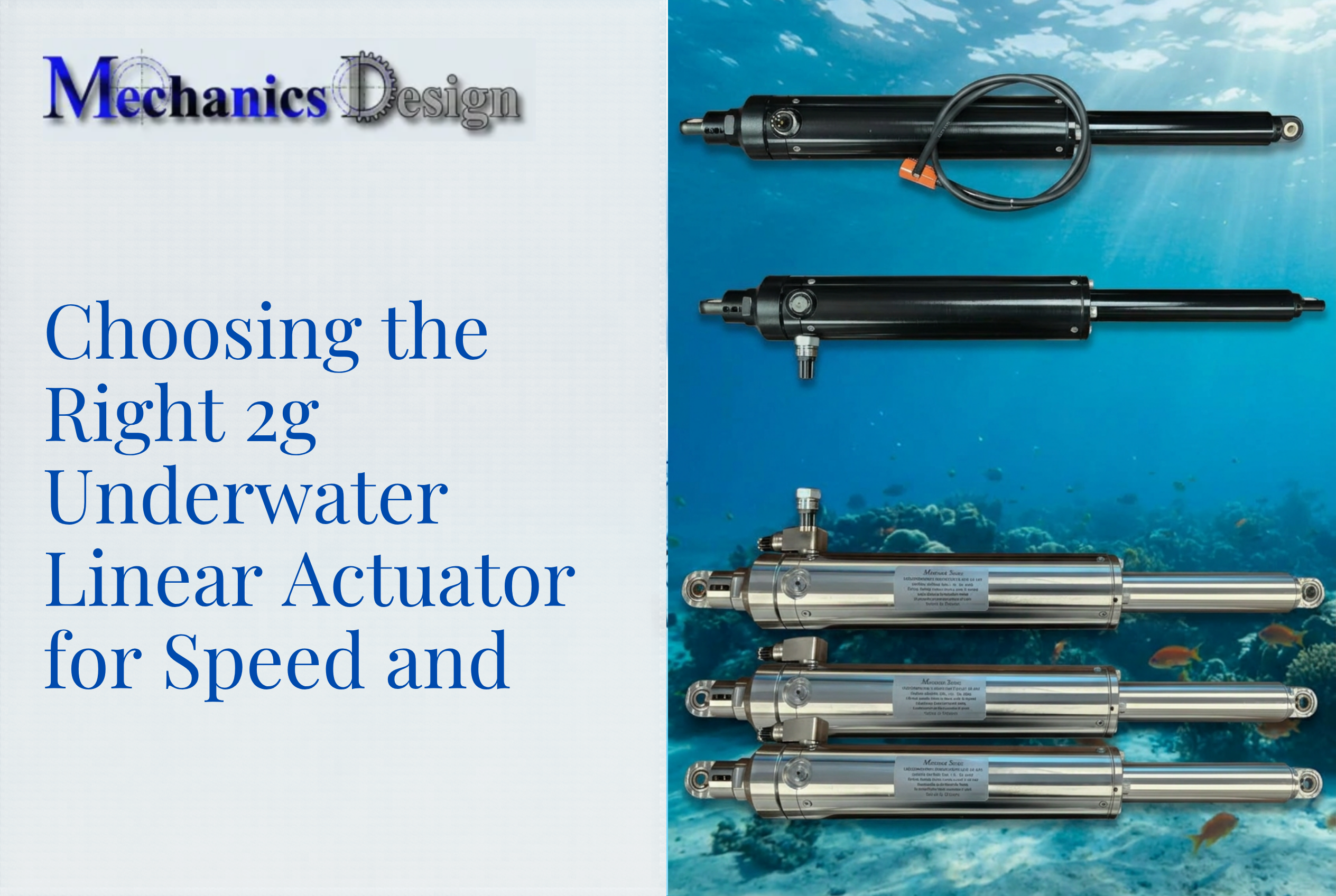
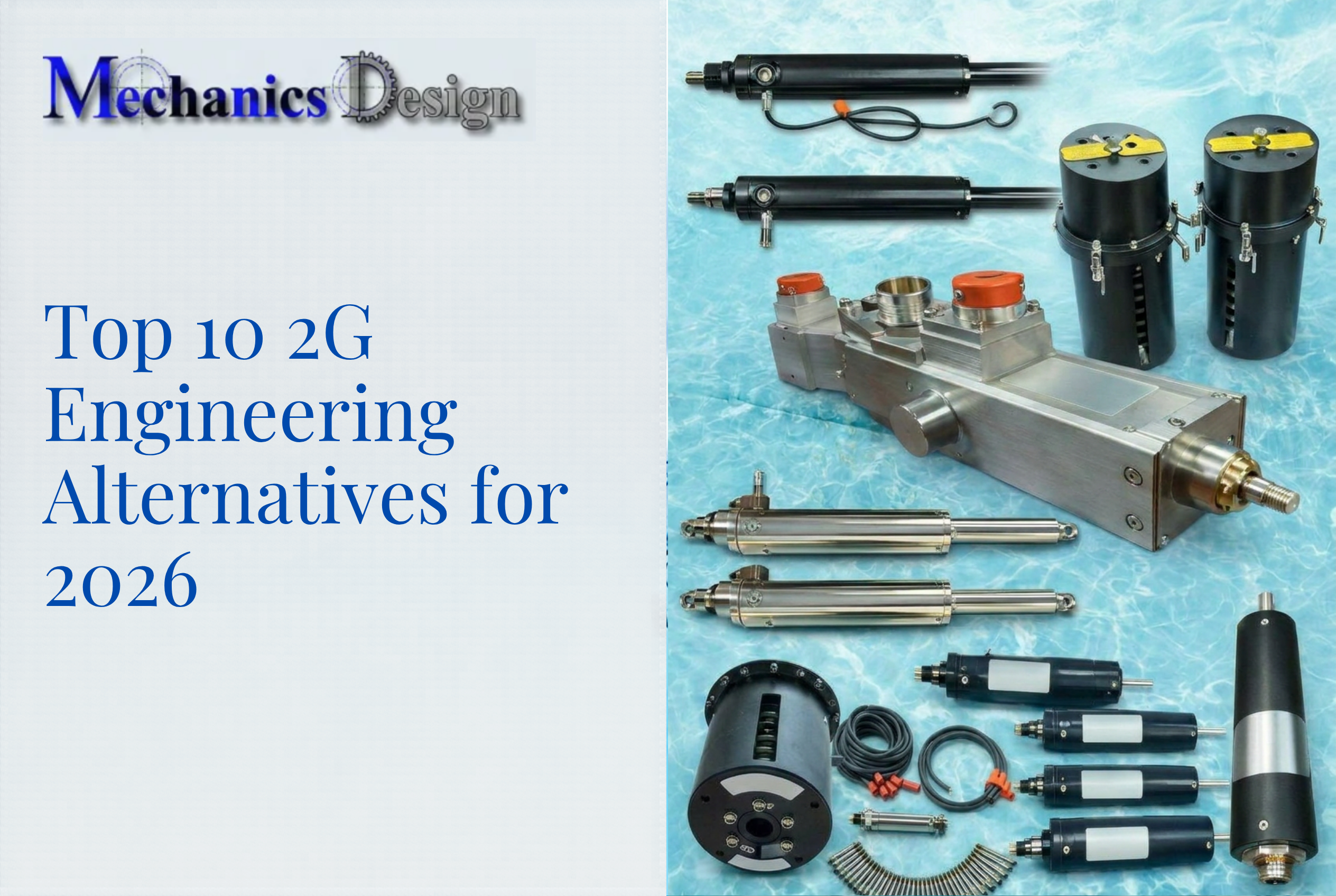
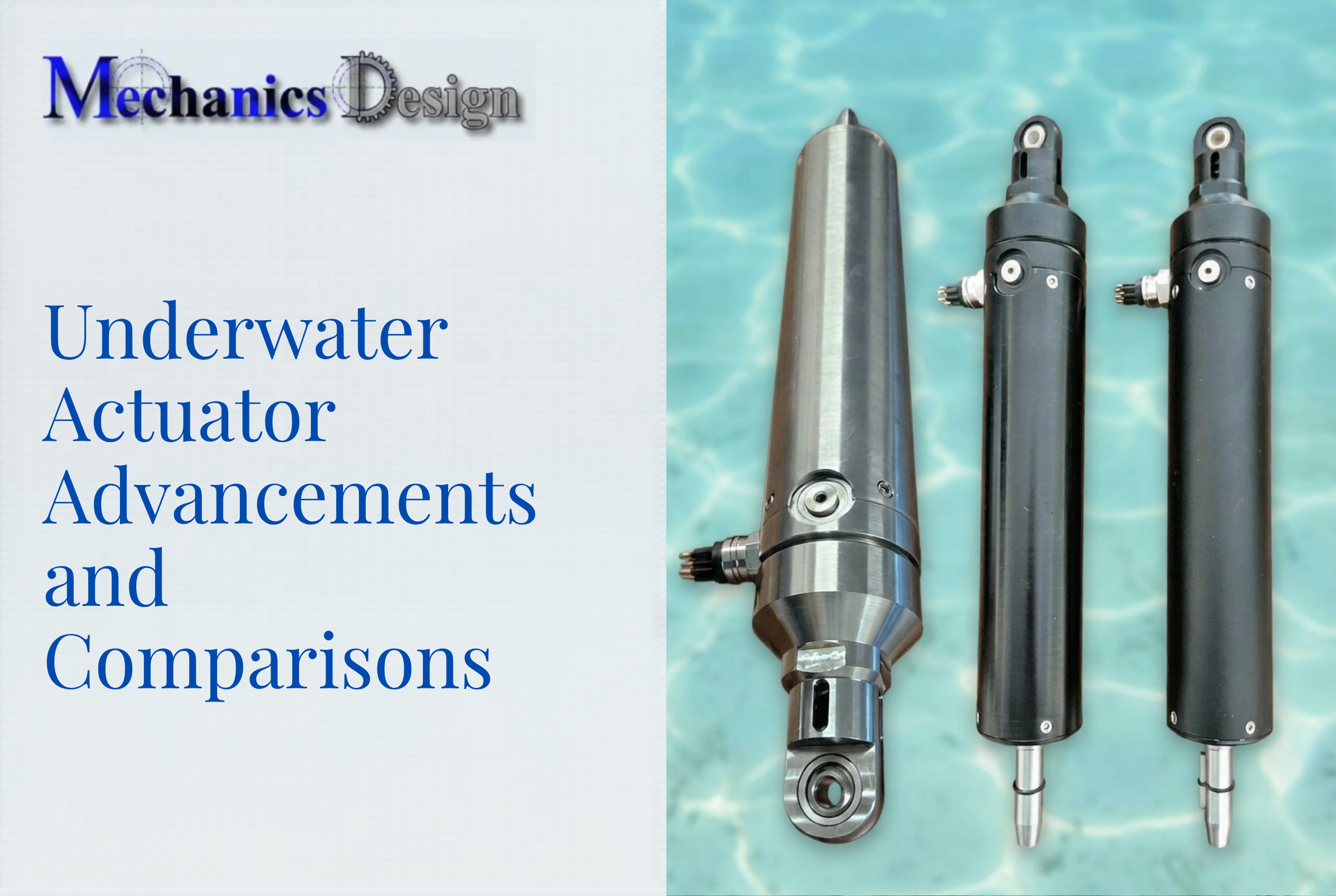
The platform keeps tanks online during cleaning (no draining required) and eliminates human entry into confined spaces. Its actuators are pressure-compensated to 3,000m, integrate 30-bit absolute encoders and RS-232 control, and include all drive circuitry within the housing—a self-contained design built specifically for municipal and industrial water operations.
Key Technical Specifications:
| Specification | Details |
|---|---|
| Depth Rating | Actuators pressure-compensated and rated to 3,000m water depth |
| Communication Protocol | RS-232 control with integrated drivers and encoders |
| Key Applications | Potable/wastewater tank cleaning and inspection; industrial cooling water systems; energy/chemical sector cooling towers |
The system's 30-bit absolute encoder retains position information between power cycles—critical for subsea operations where power interruptions are common. This eliminates the need for recalibration after system restarts, reducing operational downtime and enhancing reliability in harsh environments.
NV Mechanics' pressure compensation uses a rolling diaphragm system with 260cc oil compensators, maintaining 0.7 to 1 bar positive internal pressure to prevent seawater ingress. The self-contained housing integrates motor drivers, encoder interface boards, and communication modules—enabling plug-and-play deployment without external control electronics.
Ultra Motion (AU / U-Series)
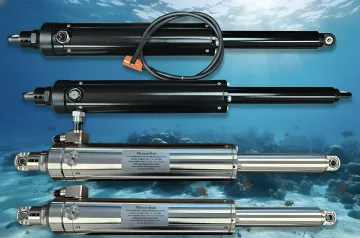
Ultra Motion, based in New York, USA, is a leading designer of high-precision electro-mechanical linear and rotary servo actuators with a 30-year heritage in subsea and maritime environments, supplying ROV, AUV, and USV platforms globally.
The AU Series features fully pressure-compensated, oil-filled enclosures with Wet-Mate connectors and Phase Index non-contact absolute position feedback, rated to 6,000m—making it a benchmark product for deep-water motion control without limit switches or external sensors.
Key Technical Specifications:
| Specification | Details |
|---|---|
| Depth Rating | Rated to 6,000m (shallow-water variants also available) |
| Communication Protocol | CAN 2.0B, RS-422 serial, RC PWM |
| Key Applications | ROV/AUV control surfaces, subsea valve actuation, hydrofoil control, USV rudder systems |
Important Note: RS-485 is strictly for diagnostics and Command Line Interface (CLI); it does not command motion. Standard electrical interfaces use SubConn Wet-Mate connectors, with custom Teledyne connectors available.
The patented Phase Index™ contactless absolute position feedback eliminates wear-prone potentiometers, enhancing reliability in extreme-depth operations. The oil-filled pressure-compensated design equalises internal fluid with external hydrostatic pressure, preventing housing collapse at 6,000-meter depths without excessively thick metal walls.
Moog Inc. (Subsea Electro-Mechanical Actuators)
Moog Inc. is a motion control manufacturer with a dedicated subsea actuator line engineered for oil and gas, defense, and offshore energy infrastructure—serving clients that require high-force, high-reliability actuation under extreme pressure.
Moog's subsea electro-mechanical actuators are designed to replace legacy hydraulic systems in permanent underwater installations, offering high force density, fail-safe locking features, and compatibility with subsea control system architectures.
Key Technical Specifications:
| Specification | Details |
|---|---|
| Depth Rating | Linear actuators rated to 9,000 PSI; rotary actuators to 1,000 PSI with modular compensators for full ocean depth |
| Force Output | Subsea Linear Actuator: 250 lbs; Subsea Integrated Linear Actuator: 40 lbs; Subsea Rotary Actuator: 35 ft-lbs torque |
| Communication Protocol | Multiple communication protocols; resolver-based position indication for motor commutation |
| Key Applications | Subsea valve control, pipeline actuators, offshore platform automation, underwater tooling systems |
Moog's linear actuators are pressure-compensated to 9,000 PSI, with resolver-based feedback ensuring accurate position indication in high-stakes subsea environments. The rotary actuators deliver 35 ft-lbs of torque with modular compensators rated for full ocean depth, covering drilling, processing, production, intervention, and defense applications.
Deep Trekker
Deep Trekker is a Canadian manufacturer of compact, portable remotely operated vehicles (ROVs) and inspection systems widely used by municipalities, utilities, and industrial operators for confined-space underwater inspection—including water tanks, reservoirs, and manholes.
Deep Trekker's DTG3 and REVOLUTION ROVs integrate propulsion and camera systems in a self-contained, diver-free platform. Their motion systems are optimized for maneuverability in confined tanks rather than high-force actuation, and the company has an established presence in North American municipal infrastructure inspection.
Key Technical Specifications:
| Specification | DTG3 ROV | REVOLUTION ROV |
|---|---|---|
| Depth Rating | 200m (656 ft) | 305m (1,000 ft) |
| Dimensions (W × H × L) | 325 × 258 × 279 mm | 440 × 235 × 717 mm |
| Weight (in air) | 8.5 kg (18.7 lb) | 26 kg (57 lb) |
| Propulsion | Magnetically Coupled/Sealed | Magnetically Coupled/Sealed (6 independent) |
| Key Applications | Potable water tanks, sanitation pipes, culverts | Offshore, defence, complex municipal infrastructure |
Both models use Deep Trekker's BRIDGE technology, which integrates an 18.5" HD touchscreen display, programmable controls, and multi-port connectivity (Ethernet, USB, HDMI) in a weatherproof Pelican case. The system supports dead reckoning for accurate position tracking in GPS-denied environments.
Tethers range from 4.5mm to 6.5mm in diameter and are neutrally buoyant in water.
The portability and ease of deployment make Deep Trekker ROVs ideal for municipalities that need rapid inspections across multiple sites without investing in permanent installation infrastructure.
Bosch Rexroth (Subsea Hydraulic Motion Systems)
Bosch Rexroth is a global motion and control technology company offering subsea-rated hydraulic power units, actuators, and cylinders engineered for demanding offshore, marine, and industrial underwater environments.
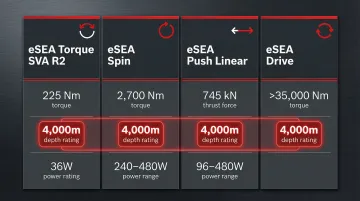
Bosch Rexroth's eSEA portfolio provides an all-electric alternative to traditional subsea hydraulics, qualified for depths up to 4,000 metres. The SVA R2 subsea valve actuator consumes up to 75% less power at peak performance compared to conventional hydraulics and eliminates kilometre-long hydraulic umbilicals.
Key Technical Specifications:
| Product Series | Motion Type | Max Force/Torque | Depth Rating | Power Consumption |
|---|---|---|---|---|
| eSEA Torque (SVA R2) | Rotary (Small Bore) | 225 Nm | 4,000m | 36 W |
| eSEA Spin | Rotary (Multiturn) | 2,700 Nm | 4,000m | 240-480 W |
| eSEA Push | Linear | 745 kN | 4,000m | 96-480 W |
| eSEA Drive | Rotary (Large Valve) | >35,000 Nm | 4,000m | Decentralised drive module |
When Hydraulic Systems Still Make Sense:
Hydraulic systems from Bosch Rexroth remain a reference standard for high-force subsea applications requiring extreme torque or force output—particularly in permanent installations like offshore oil and gas manifold actuation and heavy-duty marine infrastructure. However, their relative complexity, fluid management requirements, and dependence on hydraulic power supply make them less agile compared to electro-mechanical or robotic alternatives for municipal water tank applications.
The SVA R2's SIL 3-certified mechanical spring return achieves fail-safe emergency shutdown reliability without requiring subsea batteries, overcoming a historical limitation of electro-mechanical solutions.
How We Chose the Best Underwater Motion Alternatives
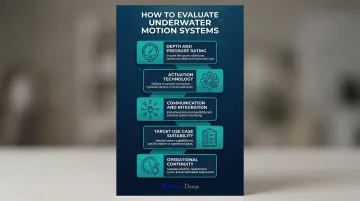
Our evaluation process assessed each system across five core criteria:
- Depth/Pressure Rating: IP and bar rating suitability for the target environment (municipal tanks typically require <20m; offshore applications need 1,000m+)
- Actuation Technology: Electro-mechanical vs. hydraulic vs. robotic platform — each suited to different force requirements and operational contexts
- Communication and Integration Flexibility: Support for standard protocols (CAN, RS-232, RS-422, RS-485) and compatibility with SCADA, ROV control panels, or supervisory systems
- Suitability for Target Use Cases: Municipal/industrial tank cleaning vs. deep offshore valve actuation vs. defence/research applications
- Operational Continuity: Ability to work without shutting down the system being serviced — critical for water infrastructure
One procurement mistake came up repeatedly across applications: buyers frequently over-specify depth ratings when their actual application is a shallow reservoir or water tank, leading to unnecessary cost and complexity.
According to the American Water Works Association (AWWA) Manual M42, typical ground-supported welded steel reservoirs have heights ranging from 24 feet to 40 feet (7.3 to 12.2 metres). IP68-rated or pressure-compensated actuators rated to modest depths are sufficient for these applications—deep-water ratings (3,000–6,000m) are relevant for offshore and subsea applications, not typical tank cleaning.
Safety credentials, service/support model, and track record in relevant industries (municipal water, energy, defence) were also considered. For organisations whose primary concern is tank cleaning and inspection, purpose-built robotic platforms are a different category altogether — they eliminate draining and confined-space entry rather than simply improving component-level actuation.
Conclusion
No single underwater motion solution fits every application. Deep offshore installations demand different actuator ratings, depth tolerances, and integration approaches than municipal reservoir maintenance or industrial cooling systems — and confusing the two leads to either under-built equipment or unnecessary cost.
Engineering managers and procurement teams should evaluate total operational cost—including draining, downtime, safety compliance, and diver costs—not just unit price or brand recognition. Depth requirements and integration complexity must match the actual application environment to avoid over-engineering.
Organizations evaluating pressure-compensated actuators, rotary drives, or subsea motion components for their next project can contact NV Mechanics Design Ltd. — a British Columbia-based manufacturer with systems rated to 6,000m depth and a track record across municipal, industrial, and offshore applications. Reach the team directly at 1-604-250-3375 to discuss your specific requirements.
Frequently Asked Questions
What are the four types of actuators?
The four primary types are hydraulic, pneumatic, electric (electro-mechanical), and mechanical actuators. In underwater motion systems, hydraulic and electro-mechanical actuators are most relevant. Hydraulic actuators deliver high force but require complex support systems, while electro-mechanical actuators offer lower maintenance, higher precision, and easier digital integration.
What is another name for a linear actuator?
Linear actuators are also commonly called servo cylinders, linear drives, or ram actuators. In underwater contexts, electro-mechanical servo cylinders are now the dominant choice over hydraulic rams, largely because they integrate directly with digital control systems without the hydraulic support infrastructure.
What depth rating should I look for in an underwater actuator for tank cleaning applications?
Most municipal water tanks and reservoirs are shallow (under 20m), so IP68-rated or pressure-compensated actuators rated to relatively modest depths are sufficient. Deep-water ratings (3,000–6,000m) are relevant for offshore and subsea applications, not typical tank cleaning. Over-specifying depth ratings increases cost and complexity unnecessarily.
How do pressure-compensated actuators work underwater?
Pressure-compensated actuators use an oil-filled, sealed enclosure where internal pressure — maintained at roughly 0.7 to 1 bar above ambient — is equalised with external water pressure. This prevents seawater ingress and allows electronics and mechanical components to function reliably at depth.
What is the difference between hydraulic and electro-mechanical underwater actuators?
Hydraulic actuators rely on pressurised fluid for force generation — high output, but requiring complex support infrastructure. Electro-mechanical actuators use motors and drive screws instead, offering lower maintenance, greater precision, and direct digital integration with no hydraulic plumbing required. Most new subsea and tank-cleaning deployments now specify electro-mechanical.
Can an underwater robotic system clean a water tank without draining it first?
Yes. Purpose-built remotely operated underwater cleaning robots—such as those offered by NV Mechanics Design Ltd.—are designed to operate while tanks remain in service, eliminating the need for draining. This cuts operational downtime, water loss, disposal costs, and confined-space entry risks associated with traditional diver-dependent cleaning methods.