Introduction
Marine environments test actuation technology like nowhere else on Earth. When an actuator fails at 3,000 meters below the surface—whether on an offshore platform, a subsea valve, or an ROV manipulator—there's no quick fix. Pressure, corrosion, and remote operation leave zero margin for error.
Across the offshore energy, naval, and subsea robotics sectors, electromechanical actuators are rapidly displacing hydraulic systems. The shift is driven by precision digital control, elimination of leak-prone hydraulic infrastructure, reduced maintenance overhead, and compatibility with autonomous operation.
According to MarketsandMarkets, the global marine actuators and valves market is projected to reach $3.6 billion by 2027, growing at a 5.3% CAGR. Electric actuation holds 18.9% market share today, expanding at 7.1% annually, fueled by smart ship automation, offshore wind, and subsea electrification.
This guide profiles the top competitors in marine and electromechanical actuation, covering their technology focus, depth ratings, and where they fit in the market.
TL;DR
- Marine electromechanical actuators control motion in offshore platforms, naval vessels, subsea robotics, and underwater inspection systems where component failure causes mission loss or safety incidents
- The market splits between industrial conglomerates and specialized subsea firms, each with different strengths in depth rating, actuation technology, and certifications
- Key selection criteria: depth/pressure rating, corrosion-resistant materials, SIL certification, pressure compensation design, and remote/autonomous control capability
- Top competitors: Moog Inc., Rotork plc, Parker Hannifin, Bosch Rexroth, Emerson Electric
- ROV and robotics applications demand pressure-compensated designs, onboard electronics, and absolute encoders—areas where purpose-built suppliers outpace generalists
Overview of Marine and Electromechanical Actuators
Marine actuators convert electrical, hydraulic, or pneumatic energy into controlled mechanical motion for use in shipboard, offshore, or subsea environments. Electromechanical actuators specifically use electric motors and drive mechanisms—eliminating the need for pressurized fluid systems that carry leakage risks and complex infrastructure requirements.
The shift toward electric actuation is accelerating across the industry. Three factors are driving adoption:
- Digital integration — RS485, Ethernet/IP, and HART protocols enable predictive maintenance and remote diagnostics
- Reduced environmental risk — no hydraulic fluid leaks in sensitive marine ecosystems
- Lower total cost of ownership — simplified maintenance routines and longer service intervals cut operating costs
Market Growth and Drivers
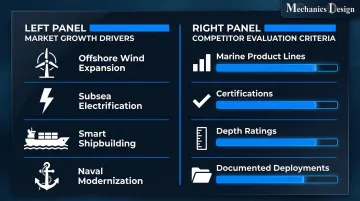
The broader global actuators market is forecast to expand from $71.22 billion in 2025 to $100.41 billion by 2030 at a 7.1% CAGR. Marine applications are contributing meaningfully to that growth, fueled by:
- Offshore wind farm expansion requiring reliable subsea motion control
- Subsea production system electrification replacing legacy hydraulic infrastructure
- Smart shipbuilding initiatives integrating networked actuation
- Naval fleet modernization programs demanding advanced, field-proven components
The competitors profiled below were evaluated on technological depth in marine-specific product lines and pressure/depth ratings. Relevant certifications (DNV, Lloyd's Register, ABS, SIL) and demonstrated deployments in commercial offshore, naval, or underwater applications were also considered.
Top Competitors in Marine and Electromechanical Actuators
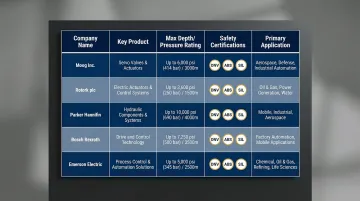
These five companies were selected for their verified marine product portfolios, technical sophistication in electromechanical systems, industry certifications, and proven track record in offshore, naval, or subsea applications.
Moog Inc.
Moog Inc. (founded 1951, East Aurora, New York) is a global leader in precision motion control serving aerospace, defence, and industrial markets. In marine and subsea sectors, Moog supplies electrohydrostatic and servo-electric actuators for offshore petroleum, oceanographic research, seismic operations, and naval shipbuilding.
Technical differentiator: Moog's Electro-Hydrostatic Actuator (EHA) technology eliminates central hydraulic systems — a critical advantage offshore where leak prevention and space constraints matter. EHA combines electric power with onboard hydraulic elements, delivering high-force output without external piping.
Key depth and pressure ratings:
- Subsea linear actuator: pressure compensated to 9,000 psi external pressure
- Subsea rotary actuator: rated to 1,000 psi, with modular compensators available for full ocean depth
Moog's electromechanical actuators are designed and tested to MIL-STD-810E and MIL-STD-461E standards. Marine slip rings carry IP68 ingress protection and hold certifications from ABS, DNV, and Lloyd's Register.
| Category | Details |
|---|---|
| Key Products / Technology | Electro-Hydrostatic Actuators (EHA), ServoControl™ electric actuators, subsea linear/rotary actuators for naval platforms |
| Depth / Environmental Rating | Subsea linear actuators: 9,000 psi; Subsea rotary: 1,000 psi (modular compensators for full ocean depth) |
| Typical Marine Applications | Offshore petroleum systems, oceanographic research, Virginia-class and Columbia-class submarine ballast control, Ford-class carrier systems |
Rotork plc
Rotork plc (founded 1945, Bath, UK) designs, manufactures, and sells electric, pneumatic, and hydraulic actuator systems for valve automation across industrial and marine sectors. Its Controls segment (electric actuators) and Fluid Systems segment serve pipeline, power generation, marine, and offshore applications globally.
Core advantage: The IQ3 Pro series integrates Bluetooth commissioning, HART communication, and SIL 3 safety certification per IEC 61508 — making it well-suited for safety-critical marine valve automation on LNG carriers, offshore platforms, and naval vessels.
Notable design features:
- Double-sealed enclosure rated IP66/IP68 (7 metres for 72 hours)
- Intrinsically safe Bluetooth Setting Tool Pro enables commissioning without opening the enclosure
Rotork holds extensive marine classification approvals: Lloyd's Register Type Approval, DNV, ABS, Bureau Veritas for the IQT3 and IQ3 ranges. The IQ3 Pro is certified SIL 2/SIL 3 for safety-instrumented applications.
| Category | Details |
|---|---|
| Key Products / Technology | IQ3 Pro electric actuators, GP/GH pneumatic actuators with fail-safe modules, fluid power systems for valve automation |
| Safety & Compliance Standards | SIL 3 (IEC 61508), Lloyd's Register, DNV-GL, ABS, Bureau Veritas |
| Typical Marine Applications | LNG vessel valve control, offshore platform emergency shutdown (ESD) systems, N05-A North Sea gas platform, FPSO vessels off Angola |
Parker Hannifin Corporation
Parker Hannifin (founded 1917, Cleveland, Ohio) is one of the world's largest motion and control companies. Its marine and offshore portfolio spans electric linear actuators, hydraulic cylinders, and pneumatic systems. The Electrak® HD series and aerospace-grade hydraulic actuators are widely deployed in offshore and marine engineering.
Key capability: Parker takes a vertically integrated approach — combining electric actuators with proprietary drives, filtration, and fluid connectors. The digital twin platform (Asset Administration Shell format) supports predictive maintenance in continuous-operation offshore environments.
Environmental and connectivity specs:
- Electrak® HD: IP69K (static), IP67 (static), IP66 (dynamic) ratings; 500-hour salt-spray tested
- Subsea ball valves depth-rated to 12,500 feet (3,810 metres)
- Built-in CANopen, SAE J1939 CAN bus connectivity
Parker holds marine approvals (DNV, ABS, Lloyd's Register, Bureau Veritas) for accumulators, hoses, and subsea valves.
| Category | Details |
|---|---|
| Key Products / Technology | Electrak® HD electric linear actuators (IP69K), hydraulic flight control actuators, subsea ball valves (3,810m rated) |
| Connectivity / Smart Features | CANopen, EtherNet/IP, HART integration; Asset Administration Shell digital twin for remote monitoring |
| Typical Marine Applications | Offshore deck equipment, marine steering and stabiliser systems, subsea tool actuation, vessel automation |
Bosch Rexroth AG
Bosch Rexroth AG (Lohr am Main, Germany, part of Robert Bosch GmbH) is a global industrial technology supplier with a growing subsea actuator portfolio. In April 2025, Bosch Rexroth and WITTENSTEIN motion control GmbH introduced the eSEA Spin—an advanced subsea electric actuator rated to 4,000 metres depth, purpose-built for offshore energy and subsea production valve control.
Why it stands out: The eSEA Spin eliminates hydraulic piping from surface to seabed. Its self-contained electric design reduces installation complexity and lifecycle costs in deep-water deployments.
Performance specs for the eSEA Spin:
- Operates on a 24V power supply
- Delivers torque up to 2,700 Nm while consuming only 480 watts
- Onboard control electronics with ROV Class 4 mechanical and SIIS L2 electrical interfaces
The related eSEA Torque actuator is DNV GL certified for SIL 3 applications per IEC 61508. The eSEA Spin was launched at Offshore Technology Conference (OTC) 2025 in Houston.
| Category | Details |
|---|---|
| Key Products / Technology | eSEA Spin subsea electric actuator (4,000m depth rated), eSEA Torque (SIL 3 certified), industrial hydraulic and electric actuator lines |
| Subsea Specific Features | Pressure-tolerant design, corrosion-resistant housing, intelligent onboard electronics, eliminates surface-to-seabed hydraulic piping |
| Typical Marine Applications | Subsea production valve control, offshore energy infrastructure, deep-sea wellhead actuation, subsea flow control |
Emerson Electric Co.
Emerson Electric Co. (founded 1890, St. Louis, Missouri) provides automation and process management solutions globally. In marine and offshore sectors, Emerson's Fisher™ valve actuator line and Aventics pneumatic actuators serve critical fluid control applications on offshore platforms, LNG vessels, and marine processing facilities, with compliance to IEC 61508 SIL 3 and API fire-safe standards.
Core advantage: The Plantweb™ digital ecosystem connects actuators as intelligent edge devices capable of real-time diagnostics, predictive failure analysis, and integration with vessel or platform management systems.
The FIELDVUE™ DVC7K and DVC6200 digital valve controllers offer:
- Microprocessor-based, HART-communicating design
- IP66-rated electrical housings
- HART 7 protocol support
The DVC6200 SIS is certified by exida as SIL 3 capable per IEC 61508. Fisher DVC positioners hold marine type approvals from DNV, ABS, Lloyd's Register, Bureau Veritas. Fisher rotary valves maintain API 607 and API 6FA fire-tested status.
| Category | Details |
|---|---|
| Key Products / Technology | Fisher™ 6200/6300 series electric/pneumatic valve actuators with DVC7K digital positioners, Aventics AV03/AV05 electric actuators |
| Safety & Compliance Standards | IEC 61508 SIL 3, API 607/6FA fire-safe standards; DNV, Lloyd's Register, ABS, Bureau Veritas marine approvals |
| Typical Marine Applications | Offshore platform process automation, LNG vessel valve control, marine water/wastewater systems, subsea pipeline actuation |
How We Chose These Marine and Electromechanical Actuator Competitors
Each competitor on this list met four core selection criteria:
- Verified marine or subsea product lines — not repackaged industrial actuators
- Recognised marine-industry certifications (DNV-GL, Lloyd's, ABS, or SIL ratings)
- Depth or environmental ratings relevant to offshore or underwater use
- Documented deployments in marine, naval, or subsea applications
Common Buyer Mistakes to Avoid
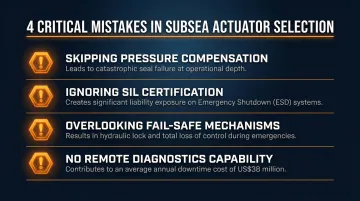
Many buyers evaluate actuators solely on force/torque specs or price—overlooking critical marine-specific factors that directly impact operational outcomes:
Pressure compensation is non-negotiable at depth. At 3,000 metres, external hydrostatic pressure reaches approximately 4,350 psi (300 bar). Without oil-filled, pressure-compensated cavities, differential pressure forces seawater past dynamic seals — and API 17D requires 200 hyperbaric test cycles to confirm seal integrity before deployment.
SIL certification protects against liability. Emergency shutdown (ESD) valve applications on offshore platforms require SIL 2 or SIL 3 certification under IEC 61508. An actuator without it creates direct liability exposure in hazardous environments.
Fail-safe mechanisms can fail silently. In spring-return actuators, insufficient pressure compensation volume during rapid valve stroking creates sub-ambient pressure — producing hydraulic lock that prevents emergency valve closure exactly when it's needed most.
Remote diagnostics cut the real cost of downtime. Subsea interventions cost 6.6 times more than surface interventions. Actuators without integrated digital communication (HART, RS485, Ethernet/IP) and onboard diagnostics drive unplanned downtime that costs offshore operators an average of US$38 million annually, based on offshore industry operational data.
Conclusion
The marine and electromechanical actuator market is not monolithic. The right supplier depends entirely on your specific application—whether topside valve automation on an LNG tanker, precision motion on a naval platform, or deep-sea subsea production systems at 4,000 metres.
Move beyond brand reputation. Before shortlisting suppliers, work through these four criteria:
- Match depth/pressure ratings to your actual operating environment
- Verify certifications align with regulatory requirements (DNV, SIL 3, API fire-safe)
- Evaluate remote operability and onboard diagnostics capability
- Calculate total cost of ownership, including intervention and retrieval costs
For applications in underwater inspection, tank cleaning, or subsea robotics, that last criterion carries particular weight. Intervention costs at depth can dwarf the actuator's purchase price many times over. NV Mechanics Design Ltd. builds pressure-compensated electromechanical actuators rated to 3,000m with self-contained onboard circuitry, absolute encoders, and RS232 control — purpose-built for remotely operated systems that need to perform without human intervention. Contact NV Mechanics at 1-604-250-3375 to discuss your depth rating and control requirements.
Frequently Asked Questions
What are the most commonly used actuators?
Electric, hydraulic, and pneumatic actuators are the three most common types. Hydraulic actuators currently dominate heavy-duty marine applications with 26.4% market share, while pneumatic actuators hold 21.8%. Electric actuators represent 18.9% of installations but are the fastest-growing category (7.1% CAGR) due to precision, lower maintenance, and digital control compatibility.
What is the difference between hydraulic and electromechanical actuators in marine applications?
Hydraulic actuators use pressurized fluid for high-force output but carry leakage risks and require extensive piping infrastructure. Electromechanical actuators use electric motors with mechanical drive systems, offering cleaner operation, easier digital integration, and no hydraulic piping—a critical advantage in subsea and enclosed marine environments where fluid leaks create environmental and operational hazards.
What depth rating should I look for in subsea actuators?
Depth ratings range from a few hundred metres for shallow-water ROVs to 1,000m–4,000m or beyond for deep-sea applications. Confirm that any actuator is pressure-compensated (oil-filled with rolling diaphragm) and that all electronics and seals are validated to your required depth through hyperbaric testing per API 17D.
How do pressure-compensated actuators work?
Pressure-compensated actuators use oil filling within the housing to equalize internal pressure with external ambient pressure at depth, preventing seal failure and housing collapse. A rolling diaphragm mechanism maintains 0.7–1 bar positive internal pressure, allowing the actuator to operate reliably at significant ocean depths where standard atmospheric-rated actuators would fail catastrophically.
What certifications are important for marine actuators?
Key certifications include marine classification society approvals (DNV-GL, Lloyd's Register, ABS, Bureau Veritas) for vessel and offshore platform use; SIL ratings (IEC 61508) for safety-critical valve applications; IP67/IP68 ingress protection ratings; and ATEX/IECEx certifications for explosive atmosphere environments found on offshore platforms.
Which actuator type is best for underwater robotics and ROV applications?
Electromechanical actuators are the standard choice for ROV and underwater robotics due to clean operation, precise digital control, and no hydraulic fluid. Look for self-contained units with pressure compensation, onboard drive electronics, absolute encoders for position retention across power cycles, and RS422/RS232 communication for autonomous operation.