Introduction
At depths exceeding 3,000 meters, subsea actuators handle valve operations that no human hand can reach — controlling hydrocarbon flow, supporting carbon capture systems, and enabling environmental monitoring in some of the harshest conditions on the planet. Pressure differentials, corrosive seawater, and years between service windows leave no room for component failure.
What's changed is the scope of what these systems are now expected to do. Operations are pushing to greater depths, regulators are tightening emissions and environmental standards, and new green energy applications are demanding actuation designs that didn't exist five years ago. Electric, pressure-compensated architectures are increasingly replacing legacy hydraulic systems across both oil and gas and emerging offshore renewables.
For engineers, operators, and procurement teams designing or maintaining underwater systems, this guide covers the key innovations reshaping subsea actuation — from depth-rated electric linear and rotary actuators to integrated sensing, position control, and what these advances mean for operational efficiency.
TL;DR
- Electric actuation is replacing hydraulic systems across subsea operations, cutting maintenance costs and eliminating fluid leak risk
- Pressure compensation technology now enables reliable actuator deployment at depths exceeding 3,000–4,000 meters
- Absolute encoders and integrated sensing deliver real-time condition monitoring, supporting predictive maintenance schedules
- Standardized ROV interfaces allow new electric actuators to drop directly into existing hydraulic infrastructure
- Subsea actuators are finding new roles in water infrastructure, environmental inspection, and industrial cleaning operations
The Shift from Hydraulic to All-Electric Actuation
Traditional subsea valve control relied on hydraulic lines running from platform to seabed: extensive piping, topside Hydraulic Power Units (HPUs), and constant maintenance. Today, electromechanical actuators powered by low-voltage DC systems (typically 24 VDC) are replacing that infrastructure entirely.
The eSEA Spin, announced at OTC 2025, shows this shift clearly: 24 VDC supply, up to 2,700 Nm of torque, and a maximum draw of just 480 watts.
How Electric Actuation Works in Practice:
Modern electric subsea actuators use redundant brushless motor configurations driving compact planetary gearboxes to achieve precise rotary torque output. For example:
- Torque output of 2,700 Nm nominal, up to 3,000 Nm maximum
- Power draw under 480 W on a 24 VDC supply
- Depth-rated to 3,000–4,000 meters reliably
This low power draw enables actuation over existing sensor cable lines, eliminating the need for dedicated hydraulic umbilicals that can span 30+ kilometers from platform to seabed.
Health, Safety, and Environmental Benefits:
That infrastructure-free design also removes one of the most persistent environmental hazards in offshore operations: hydraulic oil spills. Removing hydraulic fluid from the system removes both the marine ecosystem risk and the personnel exposure tied to routine maintenance. Electric systems no longer require specially trained offshore workers for periodic testing or post-actuation line flushing.
Cost and Operational Efficiency Case:
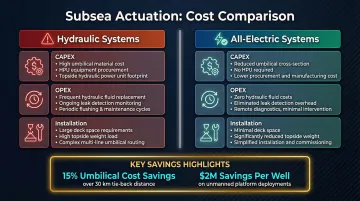
The financial case for going all-electric is well-supported by field data:
- CAPEX savings: Replacing hydraulic fluid tubes with an electric cable within an umbilical can provide a 15% cost savings over a 30-km step-out. Equinor estimates overall system cost reductions at approximately $2 million per well for unmanned platforms.
- OPEX reduction: Eliminating hydraulic infrastructure removes the ongoing costs of hydraulic fluid replacement, leak detection, and system flushing.
- Installation efficiency: All-electric systems save deck space and weight by removing HPUs and associated hydraulic control equipment.
Pressure Compensation and Deep-Water Engineering Advances
As water depth increases, external seawater pressure increases by approximately 1 bar per 10 meters, placing enormous mechanical stress on subsea actuator housings. At 3,000 meters, that's 300 atmospheres of pressure—nearly 4,400 psi. Traditional solutions involved thicker, heavier housings that increased weight, cost, and complexity.
Modern Pressure Compensation Systems:
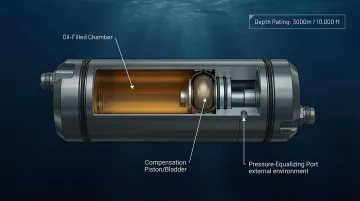
Modern actuators use oil-filled capsules connected to the actuator housing to equalize internal and external pressures. This reduces wall-thickness requirements and enables lightweight, reliable deep-water operation.
NV Mechanics Design's actuators are pressure compensated with oil and rated to 3,000 meters water depth, with all circuitry fully enclosed in a self-compensating housing. This design protects electronics and mechanical components from extreme subsea conditions without requiring oversized housings.
The compensation systems typically maintain 0.7 to 1 bar positive internal pressure using rolling diaphragm technology and stainless steel or Inconel springs. This prevents seawater ingress while allowing the internal pressure to flex with external pressure changes as the actuator moves between depths.
Service Life and Reliability:
Industry standards, specifically the IOGP S-561 supplementary specification to API 17D, mandate that subsea tree systems be designed for a 25-year life. Modern actuators align with this requirement—the eSEA Spin's gearboxes and electromechanical modules are explicitly designed for a service life exceeding 25 years. This extended reliability is achieved through fully enclosed, self-contained designs that protect against pressure ingress, corrosion, and seawater contamination.
Operational Advantages:
That long service life translates directly into broader field development opportunities. Deeper-capable actuators open access to previously unreachable reserves, with current commercial systems rated to handle:
- Standard deep-water deployments at 3,000–4,000 meters
- Ultra-deep installations with specialized components rated to 6,800 meters
- Virtually any commercially viable offshore location worldwide
Integrated Condition Monitoring and Smart Sensing
Older subsea actuators provided little to no real-time feedback. Operators had to rely on scheduled inspections or wait for catastrophic failures to identify problems. Modern subsea actuators now embed multiple sensors directly into the actuator housing to continuously record operating data for remote diagnostics.
Absolute Encoders and Position Tracking
High-resolution absolute encoders, such as the 30-bit absolute encoder mounted on the output shaft used in many advanced systems, retain precise position information between power cycles. This eliminates the need for recalibration after power interruptions—critical for autonomous and remotely operated underwater systems. The 30-bit resolution breaks down into:
- 16,383 counts per rotation via the 14-bit single-turn counter
- Multi-rotation tracking via the 16-bit turns counter
- 0.1-degree position accuracy at the output shaft
Predictive Maintenance and Downtime Reduction
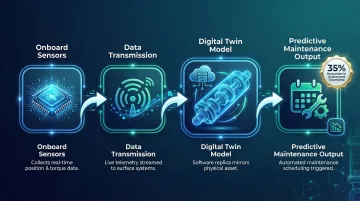
Engineers can remotely monitor actuator health, detect anomalies in torque or position, and schedule interventions before failures occur. Shell's adoption of AI-powered predictive maintenance yielded a 35% reduction in unplanned downtime and a 20% decrease in maintenance costs, saving approximately $2 billion annually across its assets, according to a report by Energies Media.
Digital Twin Integration
The eSEA Spin uses industrial sensors to continuously collect operating data, including absolute position and torque. This data feeds integrated digital twins of the components, filtering relevant information to improve actuator availability across its service life. Software models can predict wear patterns, estimate remaining useful life, and optimize maintenance scheduling — giving operators a clear picture of asset health before problems develop.
Standardized Interfaces and Drop-In ROV Compatibility
The subsea industry is coalescing around standardized mechanical and electrical interfaces that allow new electric actuators to connect directly to existing infrastructure without system-wide redesign.
Mechanical Standardization:
API RP 17H and ISO 13628-8 define the functional requirements for ROV interfaces on subsea production systems. The Class 4 torque tool interface is the industry standard for actuators delivering up to 2,700 Nm of torque—the sweet spot for most subsea valve operations.
Electrical Communication Protocols:
The Subsea Instrumentation Interface Standardization (SIIS) Level 2 protocol utilizes the CiA 443 CANopen device profile. It specifies a fault-tolerant CAN physical layer with a default bit rate of 50 kbit/s, covering subsea valves and actuator units. This standardization ensures interoperability across manufacturers and system generations.
Drop-In Replacement Benefits:
The combination of standardized mechanical (ROV Class 4) and electrical (SIIS L2) interfaces lets electric actuators act as direct drop-in replacements for legacy hydraulic modules. Operators can swap out actuators during scheduled maintenance without touching surrounding valves, trees, or manifolds. Key advantages of this compatibility include:
- Incremental modernization without replacing entire production systems
- No structural redesign of trees, manifolds, or valve assemblies
- Reduced downtime by aligning upgrades with existing maintenance windows
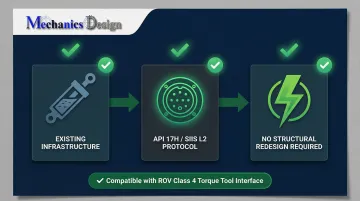
That said, ROV override capability is still a non-negotiable safety backup. When primary actuation fails, compatibility with ROV torque tools — specified under API 17H/ISO 13628-8 — ensures operators retain manual valve control at depth.
Subsea Actuators Expanding Into Green Energy and Environmental Applications
Subsea actuators are no longer exclusively used in hydrocarbon extraction. New applications include carbon capture and storage (CCS), where CO2 is injected into seabed geological formations, and green hydrogen production, where offshore electrolysis and storage systems require precise underwater valve control.
Carbon Capture and Storage
SLB OneSubsea was awarded an EPC contract by Equinor for the Northern Lights phase two project to deliver subsea CO2 injection systems and all-electric subsea trees. The use of all-electric systems in CCS eliminates hydraulic components, simplifying umbilicals for long-distance CO2 transport and reducing environmental risk in sensitive offshore environments.
Offshore Green Hydrogen
The PosHYdon pilot project in the Dutch North Sea is the world's first offshore green hydrogen production pilot, integrating offshore wind, gas, and hydrogen systems. Actuators designed for these applications must handle hydrogen-specific demands such as embrittlement resistance, seal material compatibility, and tighter safety tolerances than conventional gas service.
Environmental and Industrial Overlap
The same pressure-compensated, all-electric actuator platforms used for deepwater oilfield control now serve a wider range of applications:
- Underwater infrastructure inspection
- Environmental monitoring systems
- Industrial water system operations
- Remotely operated underwater cleaning and maintenance
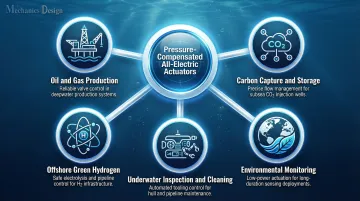
NV Mechanics Design Ltd. builds remotely operated underwater systems purpose-built for inspection, cleaning, and environmental monitoring. This cross-sector demand reflects a practical reality: the actuator technology that keeps deepwater wells running is the same technology enabling cleaner, safer industrial water operations.
What's Driving These Subsea Actuator Innovations
Four converging forces are reshaping how subsea actuators are designed, specified, and deployed.
Technology Advances
Improvements in low-voltage motor technology, compact planetary gearbox design, and automotive-grade control electronics (produced at scale for quality and cost efficiency) have made all-electric subsea actuation both technically and commercially viable. Brushless DC motors, high-resolution encoders, and integrated driver circuits now fit within compact, pressure-compensated housings rated for extreme depths.
Environmental Regulation and Sustainability Pressure
Electric technology improves the control of environmental impacts by entirely removing the risk of hydraulic fluid release into the ocean, while also improving personnel safety by removing high-pressure hydraulic equipment from topside facilities. Regulatory frameworks from the IMO and regional authorities increasingly mandate zero-discharge systems and reduced environmental footprint for offshore operations.
Cost Efficiency and Operational Economics
Subsea systems routinely operate for 25+ years, meaning even modest OPEX reductions from eliminating hydraulic maintenance accumulate into substantial savings over field life. The economic case for all-electric systems is built on several compounding factors:
- Reduced installation costs from lighter, simpler umbilical infrastructure
- Lower deck space requirements topside
- Minimal ongoing maintenance compared to hydraulic systems
- No hydraulic fluid procurement, storage, or disposal costs
Market Demand and Field Development Trends
As oil and gas exploration moves to ultra-deepwater frontiers, and new energy infrastructure (CCS, offshore hydrogen) requires seabed-level control, operators and EPCs (engineering, procurement, and construction contractors) are specifying actuators that perform reliably at greater depths, on lower power budgets, and over longer maintenance intervals.
Longer step-out distances and unmanned platform designs make hydraulic umbilicals prohibitively expensive. Pressure drop and response time constraints compound the problem — making all-electric systems the practical path forward.
Future Signals to Watch
Near-Term Developments (1–3 Years):
- Standardization of all-electric systems: Hydraulics will shift from default to exception for new field developments
- IIoT-connected actuators: Cloud-based condition monitoring platforms will enable real-time diagnostics and fleet-wide analytics
- CCS and hydrogen deployments: First commercial-scale subsea actuator-controlled carbon capture and offshore hydrogen systems will move from pilot to production
- Commercial systems rated beyond 4,000 meters will become standard as ultra-deepwater fields come online, pushing depth rating requirements beyond current norms
Medium-Term Outlook (3–5 Years):
The near-term gains listed above set the stage for a more fundamental shift. As digital twin integration matures and subsea robotics take on greater inspection and intervention roles, actuators and ROV systems will converge into tightly coupled autonomous platforms. Key developments expected in this window include:
- Smart actuators capable of self-diagnosis and software-directed operation without surface input
- Reduced reliance on human-in-the-loop commands for routine valve actuation and positioning tasks
- Closer integration between actuator firmware and vehicle control systems, enabling coordinated autonomous response to subsea conditions
Conclusion
Subsea actuator technology has shifted decisively toward all-electric, pressure-compensated, and digitally connected systems. The convergence of deep-water drive design, smart sensing, and standardized interfaces is expanding what's achievable in subsea operations—across oil and gas production, offshore renewables, and underwater robotics alike.
These innovations deliver measurable gains across four dimensions:
- Cost: Reduced capital and operating expenditures (CAPEX and OPEX) through fewer intervention cycles
- Safety: Eliminated hydraulic fluid risks and reduced personnel exposure at depth
- Environmental compliance: Zero-discharge electric systems replace leak-prone hydraulic lines
- Uptime: Predictive maintenance and extended service life reduce unplanned downtime
Operators and engineers who adopt these systems early gain a real edge — reliability, environmental performance, and verified depth ratings are increasingly the criteria that determine project viability. Partnering with suppliers who engineer for the full lifecycle of underwater deployment, from pressure compensation to digital integration, is what separates capable systems from ones that fail under pressure.
Frequently Asked Questions
What is a subsea actuator and how does it work?
A subsea actuator is a device installed on a valve to remotely open, close, or modulate flow at depth. It converts energy input—whether electric, hydraulic, or electromechanical—into precise valve motion under extreme pressure and temperature conditions, enabling operators to control subsea equipment from surface platforms or through ROV intervention.
Why are electric actuators replacing hydraulic actuators in subsea systems?
Electric actuators eliminate hydraulic pipe infrastructure from surface to seabed, cutting installation costs and removing the environmental risk of fluid leaks. They also handle long step-out distances without the pressure drop and response-time limitations that hydraulic systems face.
How do pressure compensation systems protect subsea actuators?
Compensation systems use oil-filled capsules connected to the actuator housing to equalize internal pressure with external seawater pressure at depth. This prevents pressure-induced structural damage and water ingress without requiring excessively heavy housing walls, enabling reliable operation at 3,000+ meters.
What depth ratings are typical for modern subsea actuators?
Modern subsea actuators are typically rated for 3,000 to 4,000 meters water depth, with some specialized systems rated to 6,000+ meters. These ratings are governed by API and ISO standards, with pressure compensation design serving as the primary enabler of reliable performance at extreme depths.
What industry standards govern subsea actuator design and testing?
The primary framework includes API Spec. 17D/ISO 13628-4 for wellhead and tree equipment, API 17H/ISO 13628-8 for ROV interfaces, and SIIS Level 2 (CiA 443 CANopen) for standardized electrical communication protocols.
What new applications are driving demand for advanced subsea actuators?
Beyond oil and gas, subsea actuators are now specified for carbon capture and storage (CCS) injection systems and offshore green hydrogen infrastructure. Demand is also growing in underwater robotics for environmental monitoring, subsea inspection, and industrial water system operations.